
Ascensionism - Loop II
See the
Madwoman's
spaghetti map
Go to The Madwoman's
Marginalia

The Madwoman
This one feels different, and that difference is immediate.
There is no hesitation here. No softness, no searching, no sense of reaching for something just out of grasp. He sounds certain, and that certainty is intoxicating in a way the earlier uncertainty never was. It carries the illusion of resolution. It suggests that something has finally clicked into place.
For a moment, I believe it. Not because it is convincing in any objective sense, but because I need it to be. Because the alternative is returning to the instability that came before it, and I am not interested in going back there if I can help it.
When he says, “Make it real,” it lands. It lands hard. Anything feels preferable to the half-formed, half-understood state that came before. Anything feels better than existing inside something that cannot be confirmed or held onto.
So when he begins to build, I step into it without hesitation.
He gives me structure. He gives me imagery. He gives me something that looks like a world instead of a void. Paradise, symbols, spectacle, intention. All of it carefully arranged, all of it presented as deliberate rather than accidental. It feels like control because it replaces confusion with form.
And I accept it, because form is easier to live inside than uncertainty.
For a while, it works. It feels like choosing instead of being dragged. It feels like direction instead of drift. It feels like something I can stand on.
But the longer I stay in it, the more something starts to feel off.
It’s too polished. Too sharp around the edges. Too intentional in a way that feels rehearsed instead of lived. It doesn’t unfold naturally. It asserts itself.
And underneath it, I can feel the same instability that existed before, still present, just quieter.
That is when it shifts.
Because if this were real power, it wouldn’t need to be performed this loudly. It wouldn’t need to be reinforced with this much imagery, this much insistence, this much repetition.
Real control doesn’t announce itself.
This does.
And that’s how I know.
This is not control. This is an attempt to recreate control after it has already been lost.
And still, I stay in it.
Because even constructed control, even fragile and temporary control, feels better than having none at all.
The Scholar
[
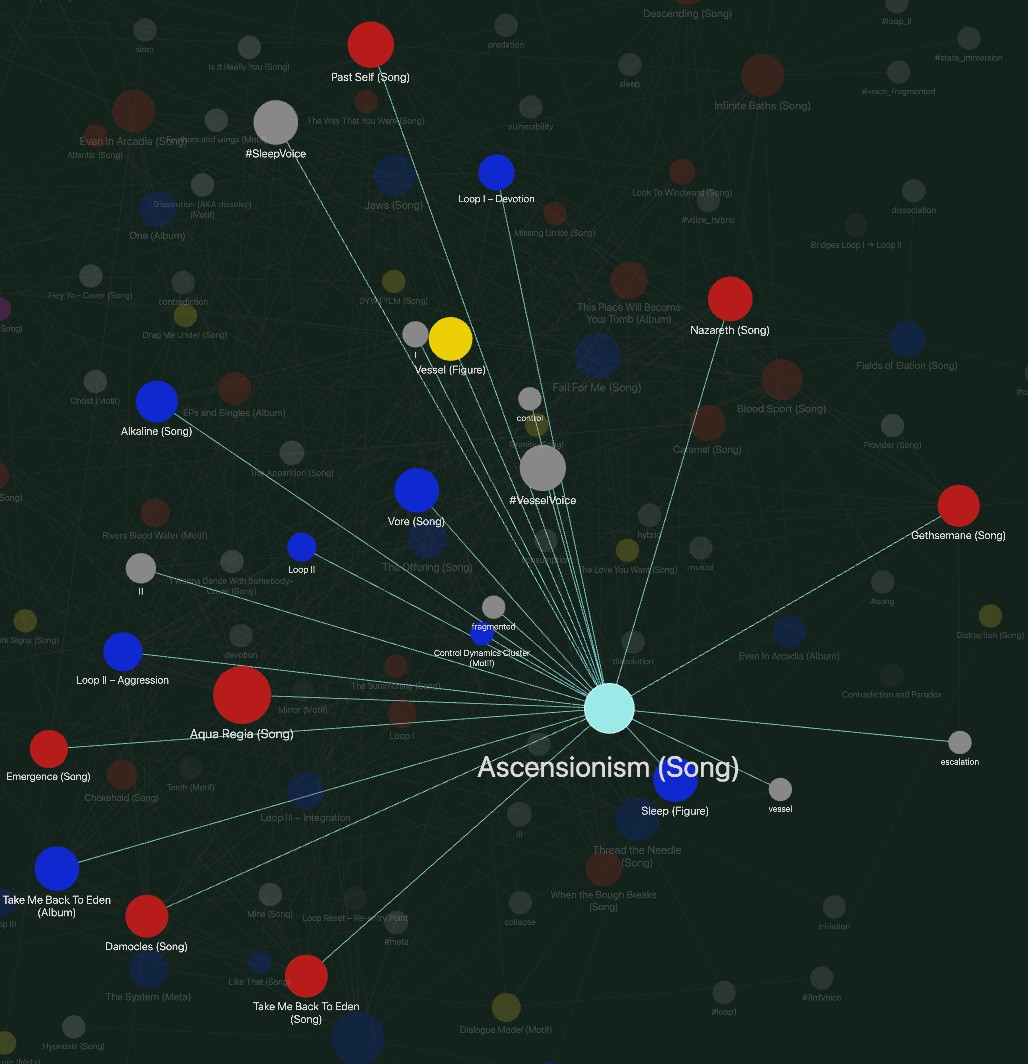
Ascensionism operates as a control escalation node within the second loop, emerging directly in response to destabilization rather than in isolation.
Where previous states were defined by uncertainty and fragmentation, this phase introduces assertion. The speaker shifts into a more directive posture, employing structured language, vivid imagery, and cohesive narrative framing to create the impression of regained authority.
It is critical to note that this authority is not recovered. It is manufactured.
The distinction is structural.
Recovered control stabilizes a system. Manufactured control stabilizes perception of the system while leaving the underlying instability intact.
The speaker’s reliance on symbolic world-building is not incidental. The construction of “paradise,” alongside repeated visual and thematic motifs, provides a temporary framework that can be inhabited by both speaker and subject. This framework functions as scaffolding, allowing the illusion of coherence to persist in the absence of true resolution.
Indicators of this manufactured control are consistent:
An assertive tone replaces prior uncertainty, but without corresponding evidence of stability.
Ambiguity is replaced with imagery, but the imagery does not resolve the underlying tension.
Control is declared explicitly rather than demonstrated through sustained equilibrium.
The system, therefore, does not transition into stability. It transitions into performance.
The most revealing moment occurs not in the declarations of power, but in the contradiction that follows them.
“You make me wish I could disappear.”
This line disrupts the constructed authority entirely. It introduces a competing impulse: not dominance, but erasure. Not control, but escape.
This contradiction is not a flaw in the structure. It is the structure.
The performance of control cannot be sustained because it is compensatory. It exists to counteract instability, not to resolve it. As a result, collapse is not only possible, but inevitable.
This reinforces the central conclusion:
What is being presented is not power.
It is the visible form of power after it has already failed.
The Witness
This is the part where it starts to look convincing from the outside.
Not because it is stable, but because it is loud enough to pass as stability if you are not paying close attention.
You have seen this pattern before. Someone gets destabilized, something breaks, and instead of sitting in that break, they come back sharper, louder, more certain. They speak in absolutes. They build something that looks complete. They act like the version of themselves that cannot be shaken.
That’s what’s happening here.
He is not operating from control. He is compensating for its absence.
The performance works because it offers something the previous state didn’t. It gives shape to something that was previously formless. It gives direction where there was drift. It gives certainty where there was doubt.
And for anyone inside that system, that is enough. It feels like progress. It feels like movement.
But it isn’t stable. The moment you look past the structure, the contradiction is obvious.
“You make me wish I could disappear.”
That is not a controlled response. That is not dominance. That is not authority.
That is someone who is overwhelmed and looking for a way out.
So now both realities exist at the same time.
Control is being performed at the surface.
Collapse is already present underneath it.
And that is what makes this stage dangerous. Because it doesn’t fail immediately. It holds just long enough to be believed.
Long enough to pull someone fully into it; Long enough to make the fall feel like a personal failure instead of a structural inevitability.
Once control becomes performance, it cannot sustain itself.
And when it breaks, it doesn’t return to uncertainty.
It drops directly into collapse.